Asynchronous vs. Live Video Support: When to Use Each for Maximum Impact
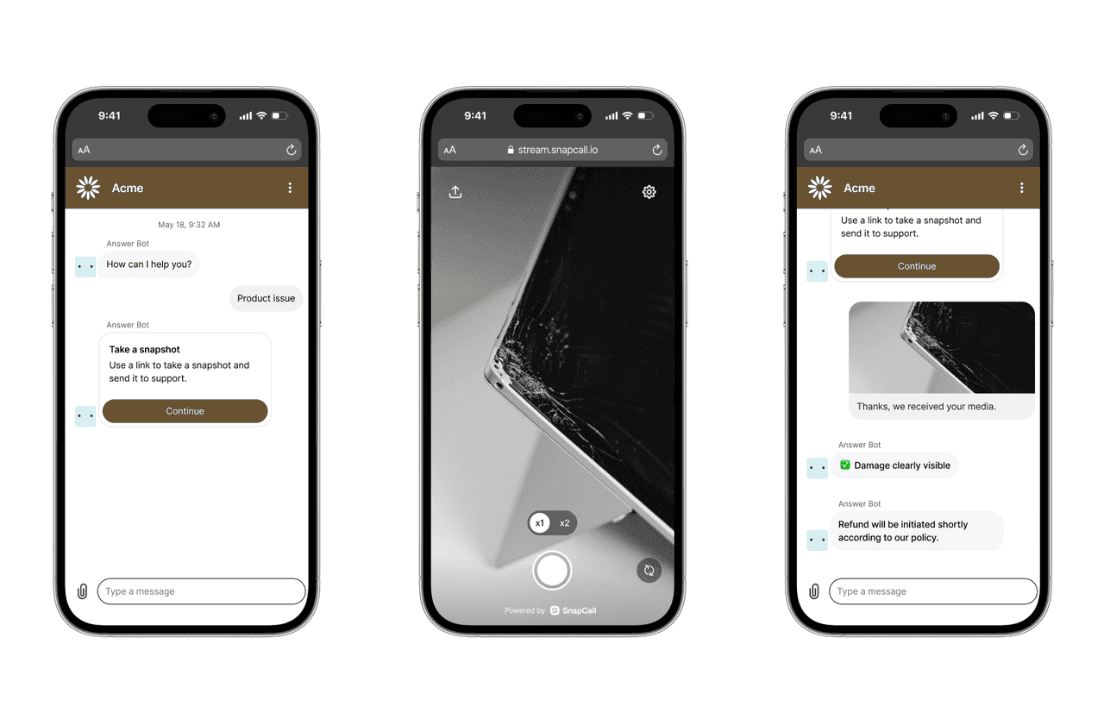
Transform your customer support strategy by leveraging both asynchronous and live video support at the right moments. Learn how leading companies achieve 46% faster resolution times with strategic visual communication.
Transform your customer support strategy by leveraging both asynchronous and live video support at the right moments. Learn how leading companies achieve 46% faster resolution times with strategic visual communication.
The Evolution of Customer Support: Beyond Text-Based Communication
In today’s digital-first world, customer support has evolved dramatically. What began as phone and email support expanded to live chat and chatbots. Now, we’re witnessing the next revolution: visual communication in customer support, which significantly enhances customer interactions.
The limitations of text-based support are well-documented:
80% of communication is non-verbal, making text-only support inherently limited
Complex issues often require multiple back-and-forth exchanges, extending resolution times
Technical problems can be nearly impossible to describe accurately with words alone
Support agents waste valuable time attempting to visualize customer issues
Video support solves these challenges by providing rich visual context. But not all video support is created equal. Understanding when to deploy asynchronous video clips versus live video calls can dramatically improve your customer experience metrics while optimizing operational costs.
Understanding Customer Service Channels
Customer service channels are the various ways in which customers interact with a company to receive support, ask questions, or provide feedback. Understanding these channels is crucial for businesses to provide effective customer service and meet customer expectations.
Customer Service Channels Overview
Customer service channels can be categorized into three main types: traditional, digital, and social. Traditional channels include phone, email, and in-person support, while digital channels encompass live chat, messaging apps, and online forums. Social channels involve social media platforms, review sites, and online communities. Each channel has its own unique characteristics, advantages, and challenges, and businesses must understand these differences to provide effective support.
Traditional channels, such as phone calls and emails, offer a personal touch and are often preferred for complex issues requiring detailed explanations. Digital channels, like live chat and messaging apps, provide quick and convenient support, ideal for resolving straightforward queries efficiently. Social channels, including social media and online communities, allow businesses to engage with customers in real-time and address public feedback, enhancing brand reputation and customer satisfaction.
By leveraging a mix of these customer service channels, businesses can create a multi-channel customer support strategy that meets diverse customer needs and expectations.
Understanding Asynchronous Video Support: Customer-Driven Visual Evidence
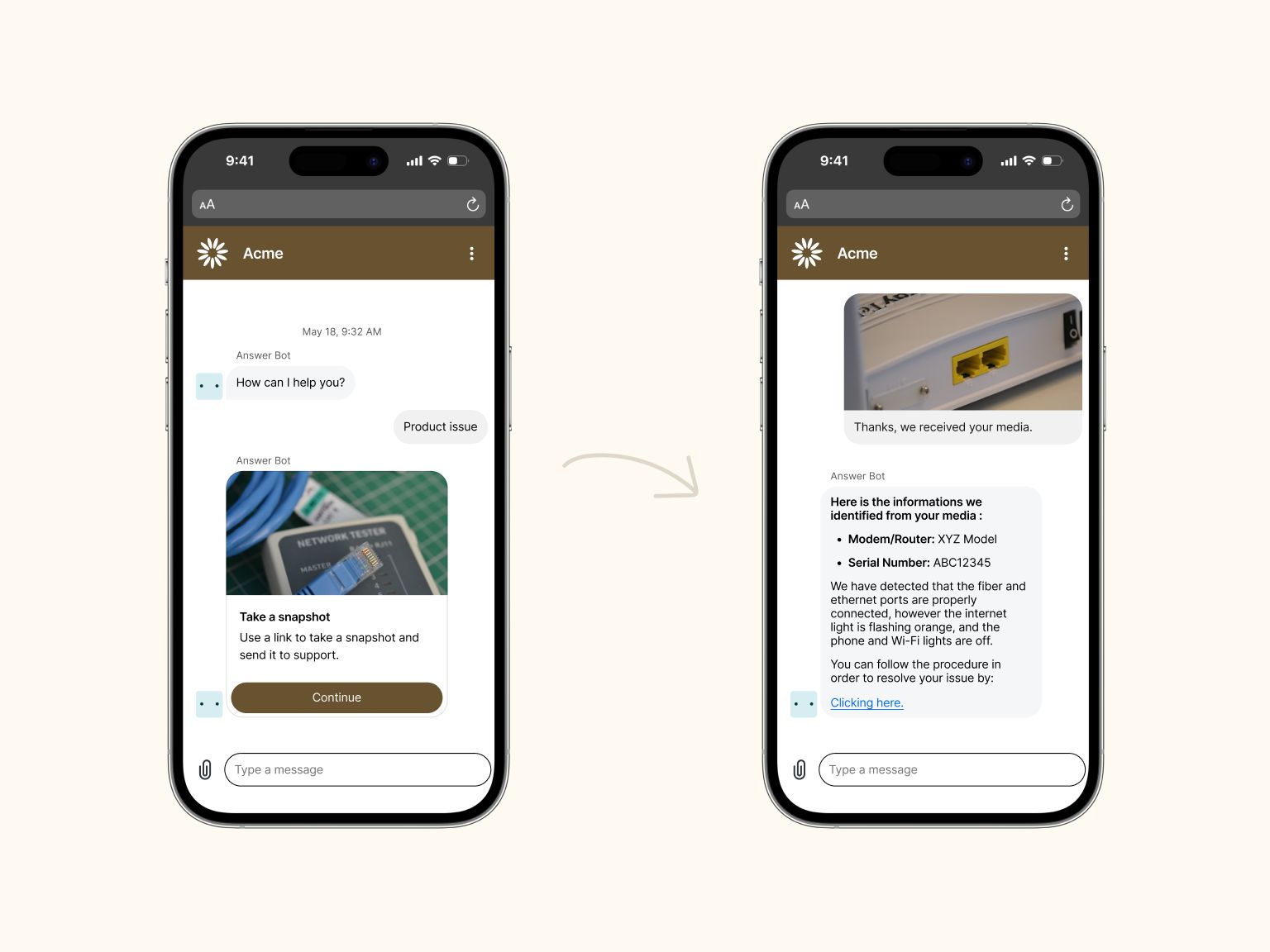
Asynchronous video support—like SnapCall Clip—allows customers to record and share video clips of their issues at their convenience, without requiring real-time interaction with support agents. These video clips can be attached to support tickets, ensuring that all relevant information is available for seamless transitions between support channels.
How Asynchronous Video Works
Customer receives a link to record video (via email, chat, SMS, or embedded in a support form)
Customer captures relevant footage showing their issue
Video is automatically processed, analyzed by AI, and attached to their support ticket
Support agents review the footage and respond with a solution
Key Benefits of Asynchronous Video Support
Convenience for customers: Record on their own schedule without waiting for an agent
Reduced support queue pressure: Agents can process video evidence efficiently
AI-powered analysis: Automatic transcription, summary, and issue detection
Permanent visual record: Documented evidence for complex cases
Scalability: Support more customers without proportional staffing increases
Ideal Use Cases for Asynchronous Video Support
Asynchronous video excels in the following scenarios:
Product issues documentation: Capturing physical defects, damaged shipments, or malfunctioning hardware
Setup verification: Confirming proper installation or configuration
Intermittent problems: Recording issues that occur sporadically
High-volume support operations: Managing large customer bases efficiently
Non-urgent support needs: Issues that don't require immediate resolution
Case Study: Devialet Achieves 46% Faster Resolution Times
Luxury audio brand Devialet implemented SnapCall's asynchronous video solution to help customers document technical issues with their speakers. The result? A 46% reduction in resolution time and a 90% CSAT score. Customers appreciated the simplicity of showing rather than describing their problems.
Understanding Live Video Support: Real-Time Visual Problem Solving
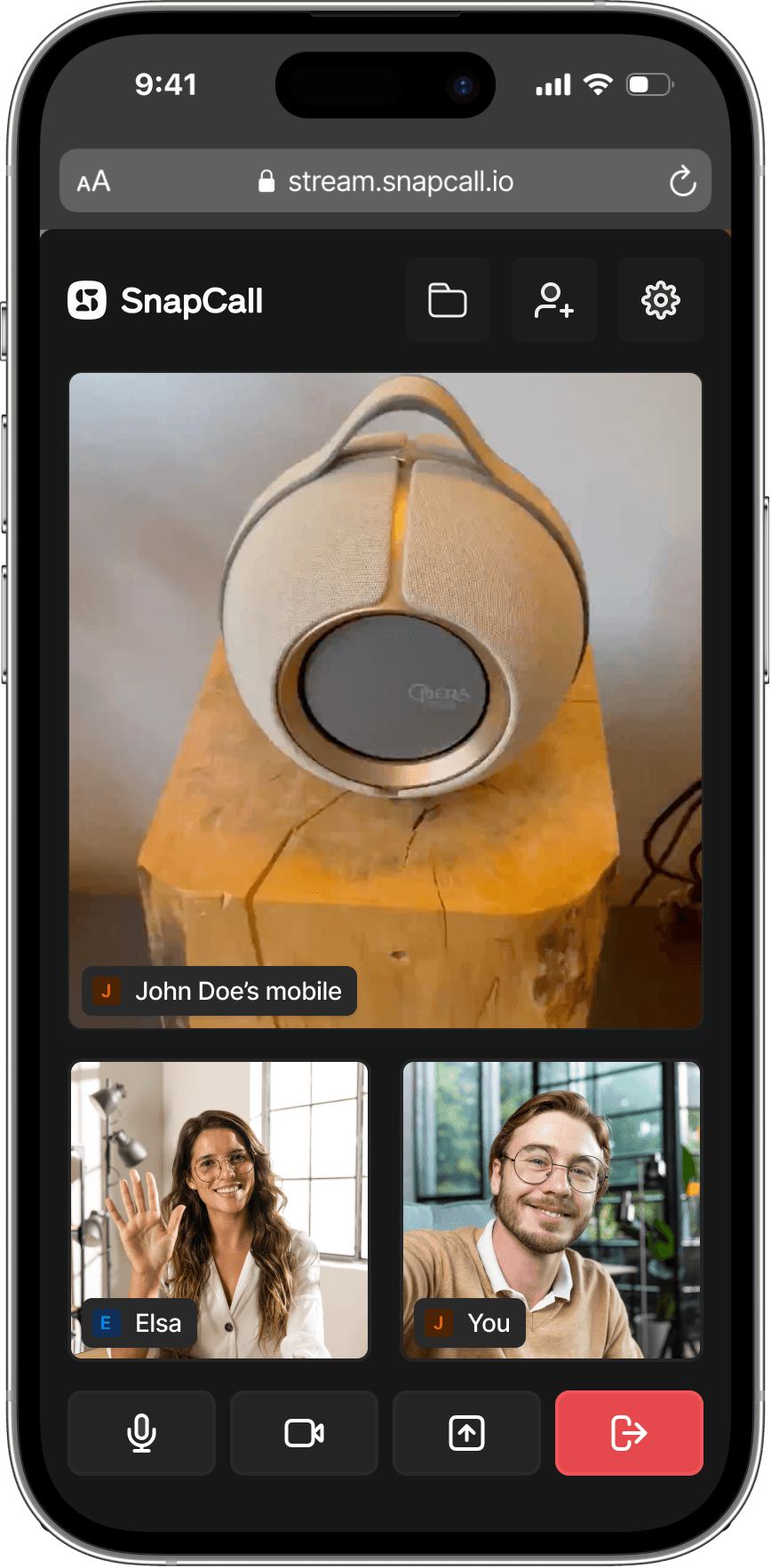
Live video support—like SnapCall Call—enables real-time video conversations between customers and support agents through various customer support channels, creating an interactive visual troubleshooting experience.
How Live Video Support Works
Customer initiates or schedules a video call through a support channel
Agent and customer connect in a real-time video session
Both parties can demonstrate, point to, and visually collaborate on the issue
Problem is diagnosed and resolved during the session
Key Benefits of Live Video Support
Immediate feedback loop: Real-time visual guidance and confirmation
Higher engagement: Building stronger customer relationships through face-to-face interaction
Complex problem-solving: Interactive troubleshooting for difficult issues
Guided resolution: Step-by-step visual assistance through complicated processes
Personalized service: Premium support experience for high-value customers
Ideal Use Cases for Live Video Support
Live video support delivers exceptional results in these scenarios:
Complex troubleshooting: Issues requiring multiple steps and verification
Technical guidance: Walking customers through configuration or repair processes
High-value customers: Delivering premium support experience to VIP clients
Urgent issues: Problems requiring immediate resolution
Sales and onboarding: Demonstrating product features or setup procedures
Case Study: Free PRO Reduces On-Site Visits by 42%
Internet provider Free PRO implemented SnapCall's live video solution to help troubleshoot router issues remotely. By enabling customers to show their setup while technicians provided real-time guidance, they reduced the need for on-site visits by 42% and increased first-call resolution by 35%.
Customer Expectations and Experience
Customer expectations play a significant role in shaping the customer experience. Customers expect businesses to provide timely, personalized, and effective support across multiple channels. Meeting these expectations is crucial for building customer loyalty, trust, and satisfaction.
Meeting Customer Expectations
To meet customer expectations, businesses must provide support that is timely, personalized, and effective. This can be achieved by using data and analytics to understand customer behavior, preferences, and pain points. By analyzing customer data, businesses can anticipate needs and tailor their support accordingly. Additionally, ensuring that customer support teams are well-trained and equipped with the necessary tools and resources is essential for resolving issues quickly and efficiently.
Strategic Decision Framework: Choosing the Right Customer Support Channels
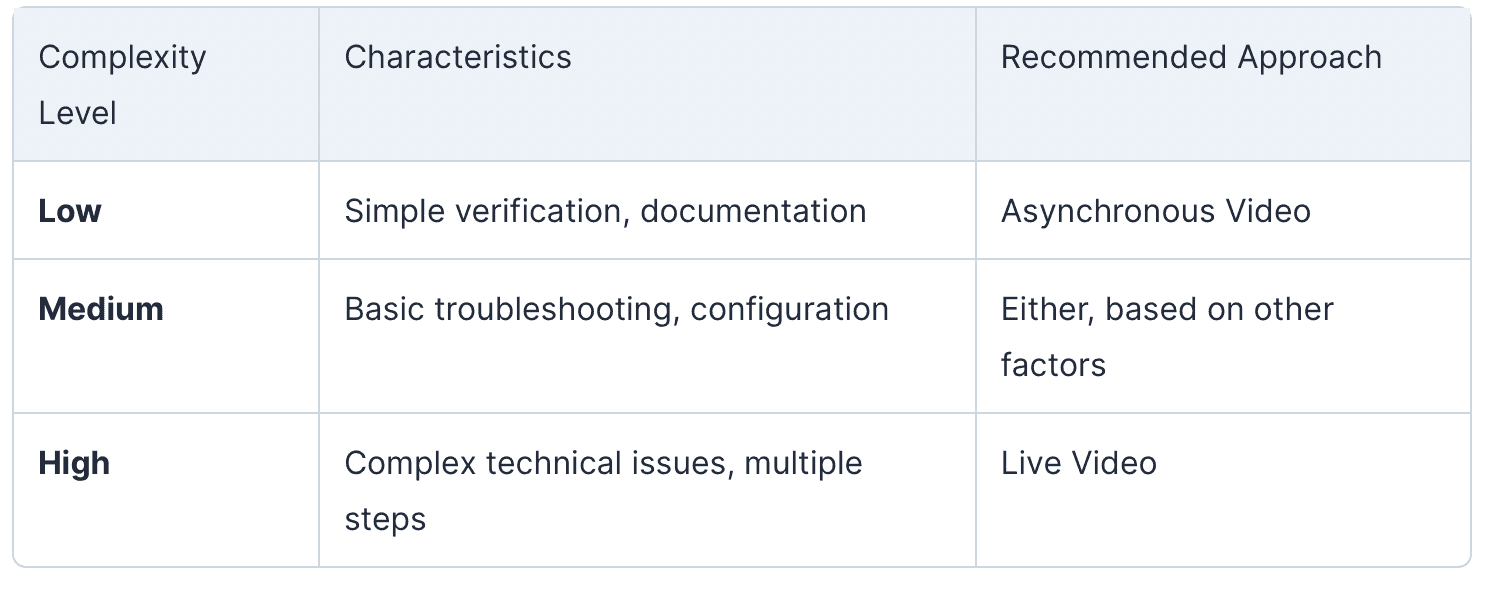
Implementing a successful video support strategy requires a clear decision framework. Consider these factors when determining whether to use asynchronous or live video support:
Issue Complexity Assessment
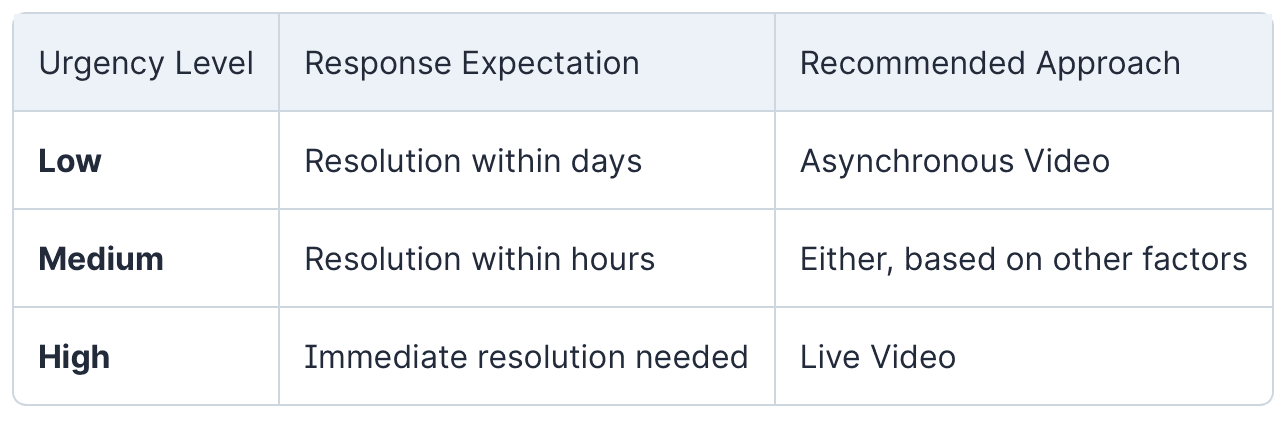
Urgency Consideration
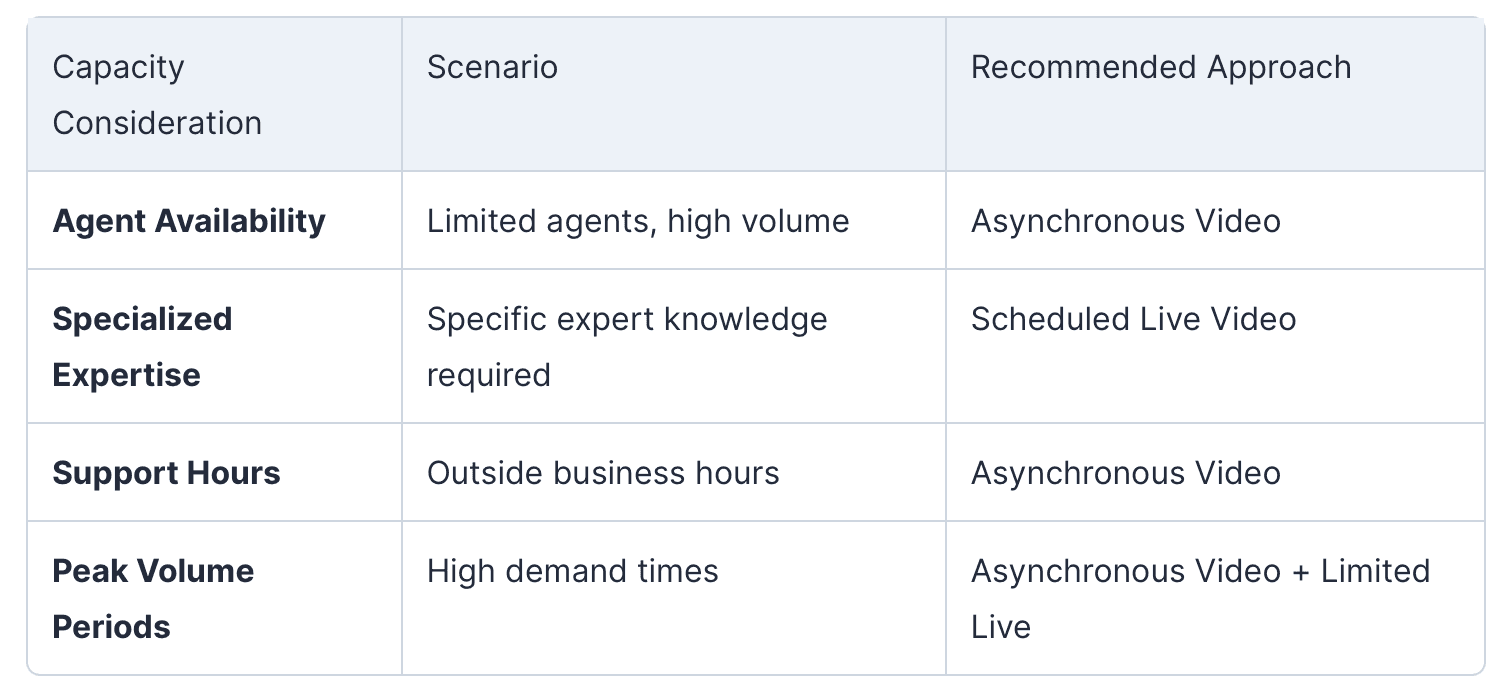
Operational Capacity Factors
Customer Segment Alignment
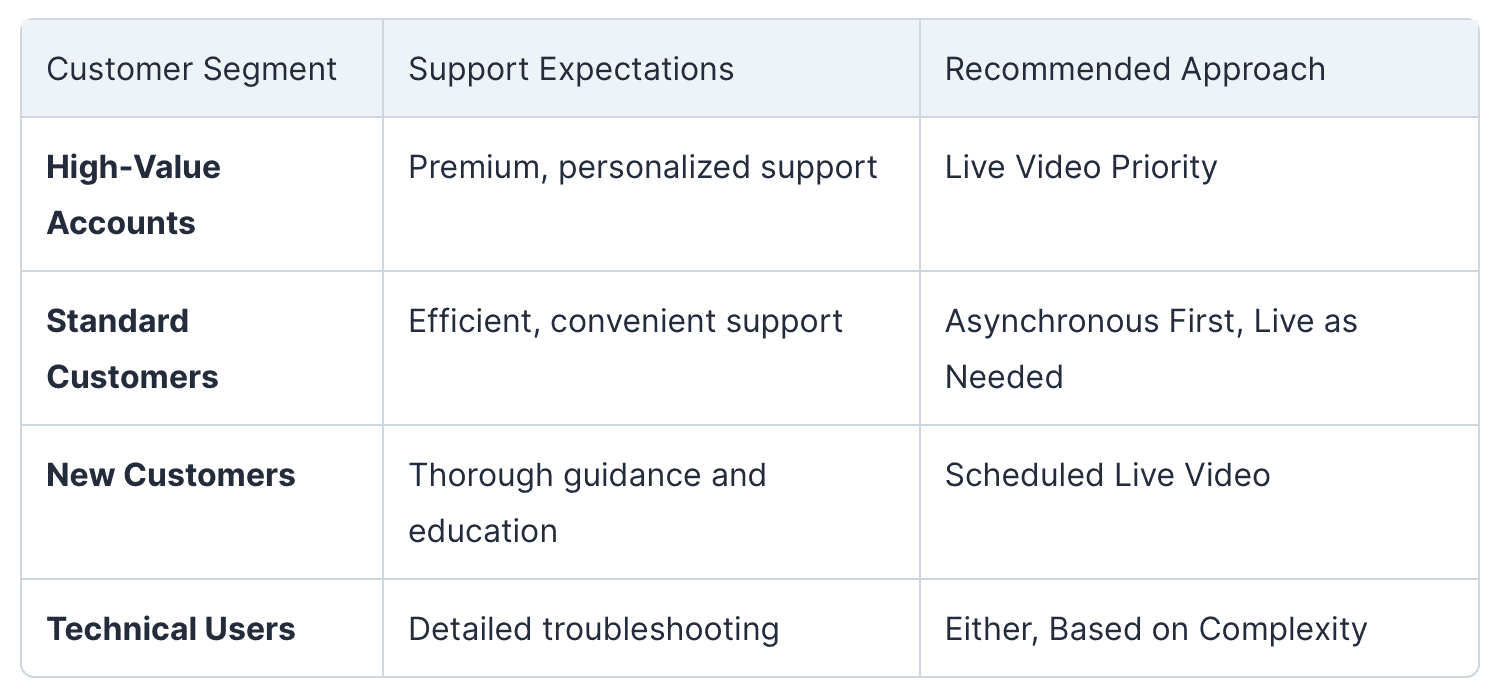
Understanding which channels customers prefer to use for support is crucial for aligning with their expectations and providing effective communication. This table outlines the support expectations and recommended approaches for different customer segments.
Implementation Best Practices: Maximizing Impact of Video Support
Successfully integrating both asynchronous and live video support requires thoughtful implementation. Follow these best practices to ensure maximum impact:
Seamless CRM Integration
Video support should integrate smoothly with your existing customer support infrastructure:
Ticket Association: Automatically attach videos to the relevant customer tickets
Agent Interface: Enable easy viewing and management of video content
Workflow Automation: Trigger appropriate workflows based on video content
Knowledge Base Connection: Link relevant support articles to common video-documented issues
Strategic Workflow Design
Develop clear workflows for when and how to escalate between support channels:
Initial Assessment: Begin with asynchronous video for issue documentation
Complexity Evaluation: Analyze video to determine if live support is needed
Escalation Triggers: Define specific criteria for upgrading to live video support
Follow-up Protocol: Capture resolution confirmation via asynchronous video
Effective Agent Training
Prepare your support team to excel with video-based support:
Visual Communication Skills: Incorporate customer service training to help agents effectively guide customers using visual cues
Customer Service Training Videos: Utilize customer service training videos to onboard new employees and enhance the skills of existing staff
Technical Proficiency: Ensure comfort with video technologies and interfaces
Issue Recognition: Develop ability to quickly diagnose problems from visual evidence
Soft Skills: Enhance personal connection abilities for face-to-face video interactions
Performance Measurement
Track key metrics to optimize your video support strategy:
Resolution Time: Measure reduction in time-to-resolution with video support
First-Contact Resolution: Track issues resolved without follow-up interactions
CSAT/NPS Impact: Monitor customer satisfaction improvements with video support
Cost Efficiency: Calculate savings from reduced support time and avoided on-site visits
Channel Effectiveness: Compare performance metrics between asynchronous and live video
Personalization and Human Touch
Personalization and human touch are essential components of customer service. Customers expect businesses to understand their individual needs and preferences, and to provide support that is tailored to their specific situation. This can be achieved by using customer data and analytics to personalize support interactions, and by ensuring that support teams are trained to provide empathetic and personalized support. When customer support agents connect with customers on a personal level, it enhances the overall customer experience and fosters long-term loyalty.
Automation and Efficiency
Automation and efficiency are also critical components of customer service. Businesses must use technology to automate routine tasks, streamline processes, and improve efficiency. This can be achieved by using tools such as chatbots, AI-powered support platforms, and workflow automation software. However, businesses must also ensure that automation is used in a way that complements human support, rather than replacing it. By balancing automation with the human touch, businesses can provide efficient yet personalized support that meets customer expectations and enhances customer satisfaction.
By understanding and addressing customer expectations, businesses can create a customer experience that not only meets but exceeds what customers expect, leading to higher satisfaction and loyalty.
Real-World Success: Companies Transforming Support with Strategic Video Implementation
Organizations across industries are achieving remarkable results by strategically implementing both asynchronous and live video support:
Retail & E-commerce
Bob’s Discount Furniture deployed SnapCall’s video support solution to assess furniture issues before sending repair technicians. By implementing a staged approach—first collecting asynchronous video evidence, then escalating to live video calls only when necessary—their customer service teams played a crucial role in leveraging this technology to enhance responsiveness and foster authentic relationships with customers. They:
Decreased resolution time by 32%
Reduced unnecessary in-home service appointments by 45%
Maintained CSAT scores above 90%
Telecommunications
Free PRO transformed their technical support operation by implementing both asynchronous and live video support. Their tiered approach begins with asynchronous video for initial issue documentation, with escalation to live video for complex router and connection problems, empowering the customer support team to enhance performance and service quality. Results include:
42% decrease in resolution time
33% increase in one-touch resolution rate
Significant cost savings from reduced technician dispatches
Finance & Banking
A major French banking institution implemented SnapCall to help customers with account setup and verification. They use:
Asynchronous video for document verification and initial issue documentation
Live video for complex onboarding and account troubleshooting
This hybrid approach resulted in:
14% decrease in resolution time
250+ media submissions monthly
150+ live interactions monthly
Enhanced security and compliance verification
Future of Video Support: Trends Shaping the Next Evolution
The video support landscape continues to evolve rapidly. Here are the key trends that will shape its future:
AI-Enhanced Video Analysis
Artificial intelligence is revolutionizing how video evidence is processed:
Automatic Issue Categorization: AI instantly categorizes problems based on visual evidence
Predictive Resolution: Systems recommend solutions based on similar visual patterns
Real-Time Guidance: AI assistants supporting agents during live video interactions
Integration of Augmented Reality
AR technology is beginning to enhance video support capabilities:
Digital Overlays: Agents can draw or highlight directly on the customer's video feed
3D Visualization: Complex products can be examined from all angles
Guided Instructions: Step-by-step visual guides overlaid on physical products
Omnichannel Video Experience
Video support is becoming a seamless part of the broader customer service channel and customer journey:
Channel Fluidity: Effortless transition between asynchronous and live video
Context Retention: Maintaining visual context across multiple interactions
Proactive Visual Support: Initiating video support based on predictive customer needs
Making the Strategic Choice: A Decision Framework
To maximize the impact of your video support implementation, follow this strategic decision framework:
Start with asynchronous video for most initial customer issues
Enables efficient visual documentation
Provides flexibility for customers and agents
Creates a valuable visual record
Escalate to live video when:
Issue complexity requires real-time interaction
Customer needs guided assistance through a process
Problem diagnosis is unclear from asynchronous footage
High-value customers require premium support experience
Implement hybrid workflows that:
Begin with asynchronous documentation
Include clear escalation triggers
Provide seamless transition between modes
Conclude with resolution verification
Conclusion: The Strategic Advantage of Multi-Modal Video Support
The most successful customer support operations don't choose between asynchronous and live video support—they strategically implement both, using each at the optimal moment in the customer journey.
By understanding the unique advantages of each approach and developing a clear decision framework, your organization can:
Reduce resolution times by up to 46%
Decrease support costs while improving quality
Enhance customer satisfaction and loyalty
Scale support operations efficiently
Video support is no longer a nice-to-have feature—it's becoming the expected standard for efficient, effective customer support. Organizations that strategically implement both asynchronous and live video capabilities position themselves at the forefront of customer experience innovation.
Ready to transform your customer support with strategic video implementation? Request a demo to see how SnapCall's comprehensive video support platform can optimize your operation.