Video vs. Traditional Support Channels: The Ultimate Comparison Guide

Customer support has evolved dramatically over the past decade. What started as primarily phone-based interactions expanded to include email, live chat, and self-service options. Now, a new contender has entered the arena: video support. But how does it stack up against traditional channels? Is it worth the investment? And which scenarios benefit most from visual communication?
Customer support has evolved dramatically over the past decade. What started as primarily phone-based interactions expanded to include email, live chat, and self-service options. Now, a new contender has entered the arena: video support. But how does it stack up against traditional channels? Is it worth the investment? And which scenarios benefit most from visual communication?
This comprehensive guide examines the strengths and limitations of each support channel, helping you determine the optimal mix for your customer service strategy.
Table of contents
Channel comparison: Breaking down the metrics
The hidden cost of non-verbal communication loss
Customer preferences: The shift toward video support
Real-world success stories
Implementation checklist: Moving from traditional to video-based support
Frequently asked questions
Channel comparison: Breaking down the metrics
When evaluating support channels, three critical metrics stand out: resolution time, customer satisfaction, and agent efficiency. Let's examine how traditional channels compare to video support across these dimensions.
Resolution time
Resolution time measures how quickly customer issues are resolved from first contact to final solution. Here's how different channels compare:

The data speaks for itself: video support dramatically reduces resolution time. For Devialet, implementing SnapCall's video support solution led to a 46% faster ticket resolution time. The visual context eliminated the need for lengthy back-and-forth exchanges that plague traditional support channels.
Customer satisfaction
CSAT scores vary significantly across channels, with video support showing promising results:
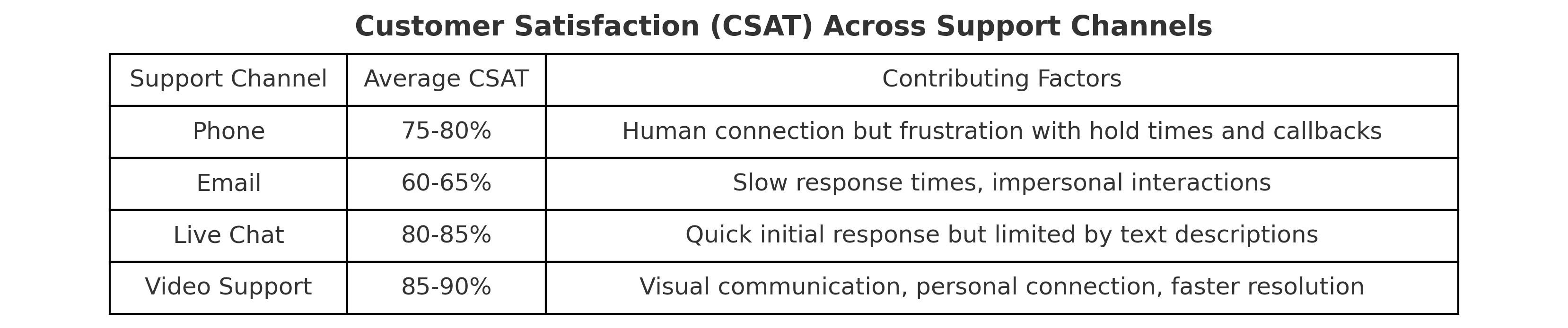
Devialet achieved an impressive 90% CSAT score after implementing video support, highlighting how visual interactions enhance customer satisfaction.
Agent efficiency
Agent efficiency measures how many tickets agents can handle effectively while maintaining quality standards:
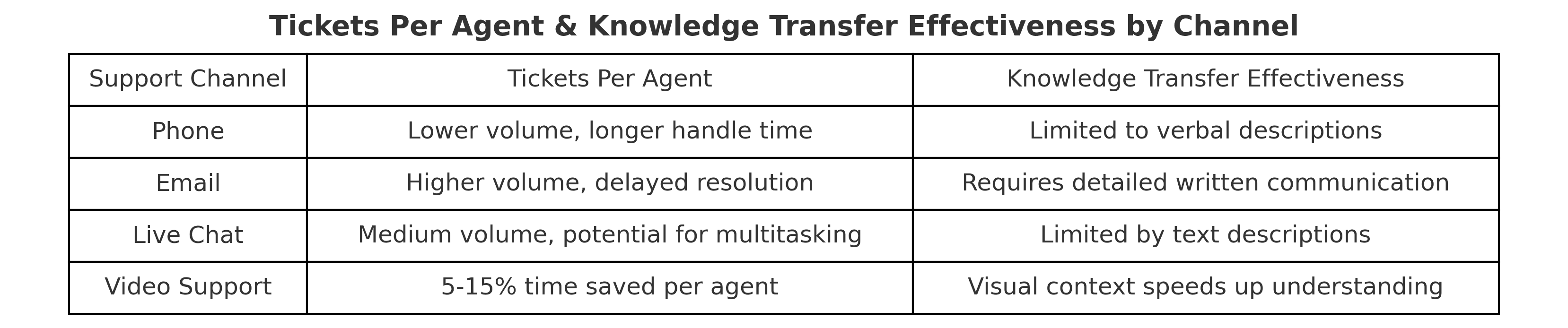
The efficiency gains with video support are substantial. SnapCall customers have reported agents saving 5-15% time when handling tickets with video support, with some companies like Free PRO experiencing a 42% decrease in resolution time.
The hidden cost of non-verbal communication loss
Traditional text and voice channels miss a crucial element of human communication: non-verbal cues. Studies show that up to 80% of effective communication is non-verbal, including:
Facial expressions
Body language
Visual demonstrations
Environmental context
When customers try to explain technical issues without visual context, miscommunications multiply. Consider these common scenarios:
Without video: "The device is making a strange noise when I press the button on the right side."
With video: The agent immediately sees the customer is pressing the wrong button or identifies the noise as normal operational feedback.
This visual gap doesn't just slow resolution—it creates frustration for both customers and agents. For companies like Devialet that sell premium electronic products, this visual understanding is invaluable for troubleshooting.
Customer preferences: The shift toward video support
Customer preferences for support channels are evolving rapidly, with significant demographic variations:
Age-based preferences
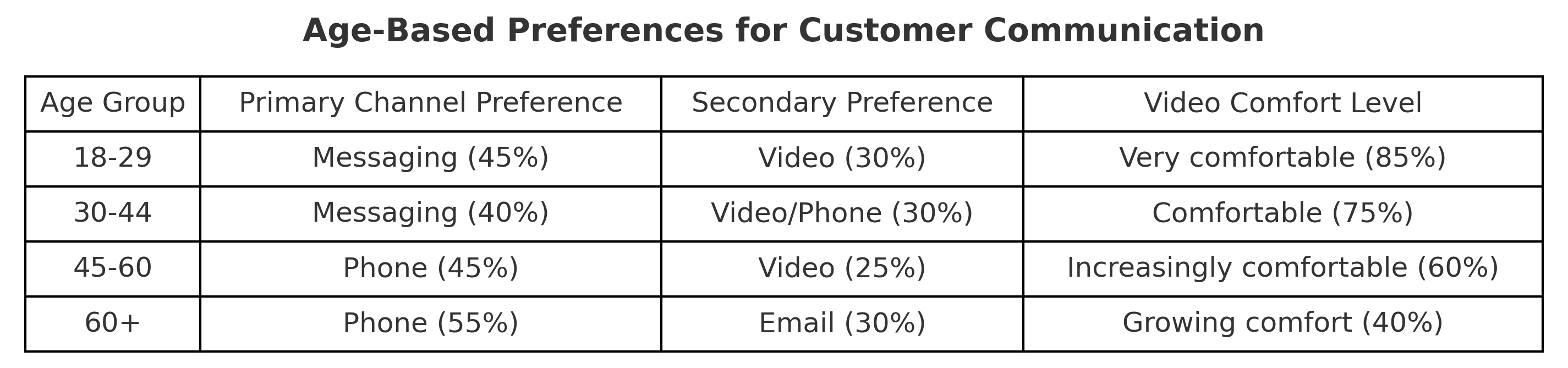
These statistics reveal an important trend: younger demographics are significantly more comfortable with video interactions, but video acceptance is growing across all age groups. This shift accelerated during the pandemic as video calls became normalized for work and social interactions.
Industry-specific preferences
Video support adoption varies by industry, with certain sectors seeing faster customer acceptance:
Retail/E-commerce: High adoption for product demonstrations and troubleshooting
Technology: Strong preference for visual technical support
Financial services: Growing adoption for visual identity verification
Healthcare: Increasing comfort with video for consultation follow-ups
A key insight from SnapCall's implementation at Free PRO (an internet provider) showed that customers actively preferred video options when troubleshooting router and connectivity issues, leading to a 42% decrease in resolution time.
Real-world success stories
Case study: Devialet premium audio
Devialet, a manufacturer of high-end audio equipment, faced challenges helping customers troubleshoot complex audio devices through traditional support channels.
Challenge: Text and phone support couldn't effectively diagnose speaker connectivity issues, leading to lengthy support interactions and unnecessary returns.
Solution: Implemented SnapCall's video support to allow customers to show their speaker setup and demonstrate issues visually.
Results:
46% faster ticket resolution
90% CSAT score
Significant reduction in unnecessary returns
The visual context enabled agents to immediately identify issues like incorrect Bluetooth pairing procedures or placement problems that were nearly impossible to diagnose through verbal descriptions alone.
Case study: Free PRO internet service
Free PRO, an internet service provider, struggled with effective remote diagnosis of connection issues.
Challenge: Phone agents had difficulty guiding customers through router troubleshooting without seeing the equipment or indicator lights.
Solution: Deployed SnapCall's video clip feature allowing customers to record their setup and show router status.
Results:
42% decrease in resolution time
650+ media clips received monthly
140+ live interactions monthly
Significant reduction in on-site technician visits
The ability to see router configurations, cable connections, and indicator lights transformed their support efficiency and reduced costly technician dispatches.
Implementation checklist: Moving from traditional to video-based support
Transitioning to video support requires thoughtful implementation. This checklist provides a roadmap for organizations looking to enhance their support strategy:
1. Assessment and planning
Audit current support channels and performance metrics
Identify specific use cases where visual communication would add most value
Define goals and KPIs for video support implementation
Select technology solution with right features (asynchronous clips, live calls, AI capabilities)
2. Technical implementation
Ensure CRM integration with existing systems (Zendesk, Intercom, etc.)
Set up appropriate security and privacy protocols
Test bandwidth and system requirements
Create automation triggers for offering video support options
SnapCall can be integrated into Zendesk with a one-click installation, making this process straightforward for organizations already using this CRM.
3. Agent training
Develop video communication guidelines and best practices
Train agents on technical aspects of video support tools
Practice common troubleshooting scenarios using visual communication
Create visual reference materials for common issues
4. Customer communication
Update support documentation to highlight video options
Create simple customer instructions for accessing video support
Develop criteria for when to offer video support
Design feedback mechanisms to measure customer experience
5. Measurement and optimization
Monitor key metrics: resolution time, CSAT, agent efficiency
Collect and analyze feedback from agents and customers
Identify opportunities for AI-assisted analysis of video interactions
Iterate on processes based on performance data
Organizations like Devialet found that starting with specific use cases (like product troubleshooting) provided quick wins before expanding video support to other scenarios.
Frequently asked questions
How does video support impact support costs compared to traditional channels?
Video support typically reduces overall support costs by decreasing resolution time and avoiding unnecessary escalations. While there may be initial implementation costs, companies like Free PRO have seen significant ROI through reduced on-site technician visits and faster resolution times (42% improvement). The visual context enables first-touch resolution for many issues that would otherwise require multiple interactions.
Is video support appropriate for all types of customer issues?
Not every support interaction requires video, but certain scenarios benefit tremendously from visual context:
Technical troubleshooting
Product assembly or usage guidance
Damage or defect verification
Complex processes requiring demonstration
Identity verification
Organizations should identify high-value use cases where visual communication solves problems more effectively than text or voice alone.
What about customers with privacy concerns or limited technology access?
Video support should always be optional, with traditional channels remaining available. SnapCall's implementation allows for:
Customer-initiated video sharing (opt-in approach)
Asynchronous video clips as an alternative to live calls
Option to share only what customers are comfortable showing
Low bandwidth alternatives when needed
How does AI enhance video support?
AI capabilities transform video support beyond simple visual communication:
Automatic analysis of video content to identify products and issues
Extraction of key information to populate support tickets
Suggested knowledge base articles based on visual assessment
Transcription and summarization of video interactions
For example, SnapCall's AI can automatically identify Devialet product models and serial numbers from video clips, speeding up the support process.
How long does implementation typically take?
Implementation timelines vary based on organization size and complexity, but SnapCall's one-click installation with Zendesk allows for rapid deployment. Most companies can begin offering video support options within days or weeks rather than months. The key is starting with specific high-value use cases before expanding.
The evolution of customer support continues with video emerging as a powerful channel that addresses limitations of traditional text and voice interactions. By providing visual context, video support reduces resolution times, improves customer satisfaction, and increases agent efficiency—creating better experiences for everyone involved.
For organizations ready to enhance their support strategy with visual communication, solutions like SnapCall offer both live video calls and asynchronous video clips that integrate directly with existing CRM systems.
Want to see how video can transform your customer support experience? Explore how leading companies are using visual communication to solve customer issues faster and more effectively.