Video Clips: How AI is Transforming Customer Service - The Ultimate Guide to Asynchronous Video Support
Video AI customer service is revolutionizing support with asynchronous video clips. See how companies achieve 46% faster resolutions and reduce operational costs by 37%.
Table of contents
Why traditional customer service channels fall short
Enter video AI: The game-changer for customer support
What is asynchronous video support?
How video clips and AI are revolutionizing customer service
Key benefits of video AI in customer service
Real-world success stories: Companies winning with video support
How to implement video clips in your customer service strategy
The future of customer support: Where video AI is headed
FAQs about video AI customer service
Why traditional customer service channels fall short
Picture this: a customer is struggling with your product. They send an email explaining the issue, but their description is vague. Your support agent responds with questions, the customer clarifies, more questions follow – and suddenly, a simple issue has turned into a week-long email thread.
Sound familiar? You’re not alone.
Traditional customer service channels have significant limitations:
Phone calls are limited to voice communication, missing 80% of non-verbal cues, and require dedicated staff time for each interaction
Text-based support often leads to frustrating back-and-forth exchanges that can stretch over days
Email lacks visual context, making complex issues difficult to explain and understand. Screen recordings can provide visual context and make complex issues easier to explain and understand.
Live chat provides quick responses but still misses crucial visual information
The result? Longer resolution times, frustrated customers, and higher operational costs. In today’s world where customers expect quick, effortless solutions, these limitations can seriously impact customer satisfaction and loyalty.
Enter video AI: The game-changer for customer support
What if your customers could simply show you their problem instead of trying to explain it?
Video technology is transforming customer service by bridging the communication gap between businesses and their customers. By incorporating visual elements into customer interactions, companies are solving problems faster and more effectively than ever before.
The numbers speak for themselves:
46% quicker ticket resolution
11% reduction in average ticket numbers
5-15% of tickets can have videos attached with minimal effort
Up to 30% increase in customer satisfaction
Video chatbots can provide 24/7 support, enhancing customer satisfaction by offering a more empathetic and engaging experience without the limitations of human agents.
Video AI customer service isn’t just another tech trend – it’s a fundamental shift in how businesses and customers communicate.
What is asynchronous video support?
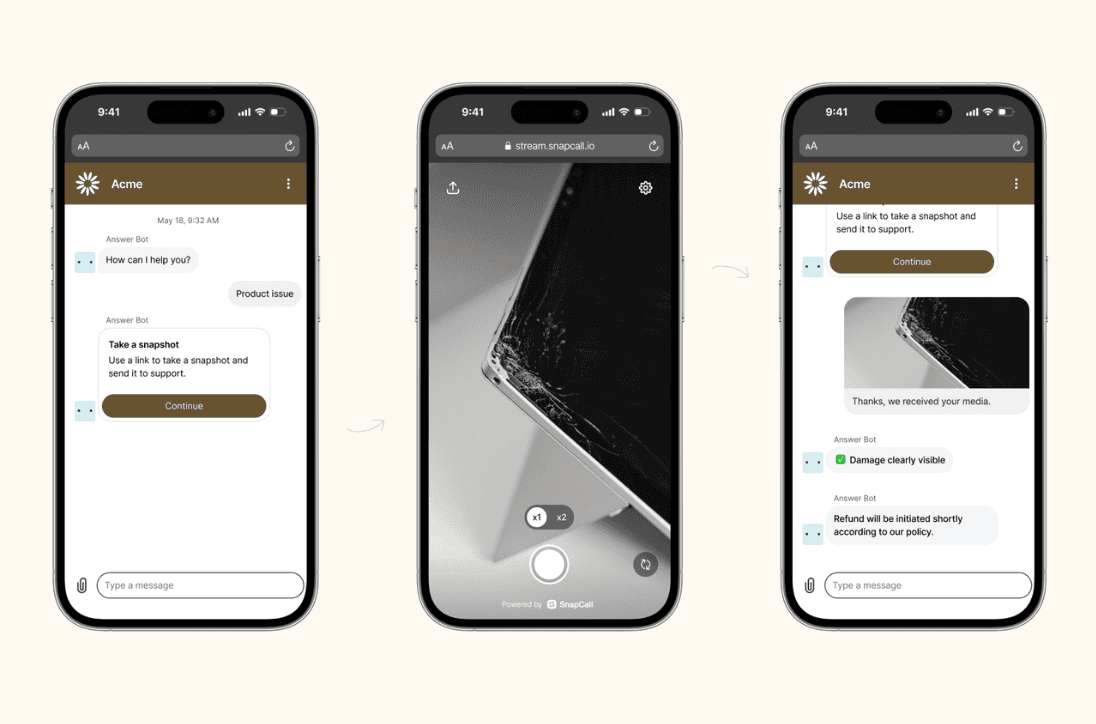
Asynchronous video support allows customers to record videos of their issues at their convenience, which are then reviewed by support teams when they’re available. Unlike live video calls (which are synchronous), asynchronous support doesn’t require both parties to be present simultaneously.
Here’s how it typically works:
A customer encounters an issue with a product or service
The customer receives a link to record a video clip demonstrating the problem
The customer captures the issue using their smartphone or computer camera
The video is automatically uploaded and attached to their support ticket
Support teams review the video, diagnose the issue, and provide a solution
Companies have created various types of video content to enhance customer engagement. The beauty of asynchronous video support is its flexibility – customers can record videos whenever it’s convenient for them, and support teams can process these videos efficiently without the pressure of a live conversation.
What is Video Conversational AI?
Video Conversational AI is a groundbreaking technology that combines natural language processing (NLP) and computer vision to enable computers to understand, process, and respond to human language through video interactions. This advanced form of artificial intelligence creates a virtual assistant capable of engaging with customers in a more personalized and human-like manner.
Imagine a virtual customer service team that can answer frequently asked questions, provide detailed product information, and even conduct transactions—all through video. This technology can be seamlessly integrated across multiple platforms, including websites, mobile apps, and social media channels, ensuring a consistent and engaging customer experience.
One of the standout benefits of Video Conversational AI is its ability to offer 24/7 support without the need for live agents. This means customers can get the help they need at any time, significantly reducing wait times and boosting satisfaction. The result? Increased customer loyalty and retention.
But the advantages don’t stop there. Video Conversational AI can also create personalized video content tailored to individual customer needs and preferences. Whether it’s a personalized video message, a video call, or even live video calls with customer service representatives, this technology ensures that every interaction feels unique and relevant.
For customer service teams, Video Conversational AI is a game-changer. It can analyze customer queries, providing valuable insights that help agents respond more effectively. This not only improves the efficiency of the support team but also enhances the overall customer experience.
In summary, Video Conversational AI has the potential to revolutionize the way businesses interact with their customers. By offering a more personalized, efficient, and effective customer experience, it sets a new standard for customer service in the digital age.
How video clips and AI are revolutionizing customer service
The real magic happens when you combine video clips with artificial intelligence. Modern video support platforms don’t just collect videos – they analyze them to extract valuable insights.
Here’s what advanced video AI can do:
Automatic transcription: Convert spoken content in videos to searchable text
Content recognition: Identify products, serial numbers, and issue types automatically
Sentiment analysis: Gauge customer emotions to prioritize urgent cases
Issue categorization: Automatically route tickets to the right department
Knowledge base suggestions: Recommend relevant support articles based on video content
AI-generated responses: Create draft responses for agents to review and personalize
For example, when a customer sends a video of a malfunctioning electronic device, AI can identify the product model, recognize error codes on the screen, and suggest the most likely solutions – all before a human agent even views the ticket.
This combination of visual information and AI-powered analysis is what makes modern video support so powerful. Agents get all the context they need to solve issues quickly, while customers enjoy a frictionless experience. Additionally, this combination can modernize the customer journey and enhance customer engagement by providing interactive and efficient solutions.
Key benefits of video AI in customer service
Implementing video clips and AI in your customer service strategy delivers significant advantages:
Lower operational costs
Video support helps you handle more interactions without proportionally increasing costs. AI-powered analysis means agents spend less time figuring out what's wrong and more time solving problems. Many companies report cost savings of 15-37% compared to traditional support channels.
Reduced customer friction
Nobody enjoys writing detailed problem descriptions or going through lengthy troubleshooting steps. Video clips allow customers to simply show the issue, reducing effort and frustration. This improved experience translates to higher satisfaction scores and better customer retention.
Faster resolution times
With video clips, agents immediately see what's happening, eliminating the guesswork and back-and-forth communication. Companies typically see resolution times decrease by 32-46% after implementing video support.
Improved first-contact resolution
When agents can see the full context of an issue, they're more likely to solve it on the first interaction. This not only improves efficiency but also significantly enhances customer satisfaction.
Enhanced issue understanding
Some problems are simply difficult to describe in words. How do you explain an unusual noise your device is making or a specific error message that appears intermittently? Video makes these explanations immediate and clear.
Real-world success stories: Companies winning with video support
Let's look at how real businesses are transforming their customer service with video AI:
Devialet (Audio Technology)
Implemented asynchronous video clips for hardware troubleshooting
Achieved 46% faster resolution times
Processes many customer videos monthly
Customers can easily demonstrate Bluetooth connectivity issues, software configurations, and hardware problems
Free PRO (Internet Provider)
Uses video clips to diagnose home internet router issues
Reduced resolution time by 42%
Processes a lot media submissions monthly
Conducts many live interactions monthly
Minimized the need for costly on-site technician visits
Bob's Discount Furniture
Implemented video clips for warranty and delivery issues
Decreased resolution time by 32%
Receives 700+ media submissions monthly
Conducts 300+ live interactions monthly
Significantly reduced the need for in-person service visits
Meubles RD (Furniture & Mattress Store)
Uses video clips to verify product issues
Increased one-touch resolution by 33%
Assists over 100 customers monthly
Processes over 1kmedia submissions monthly
Minimized product returns through better remote diagnostics
These examples show how video support works across different industries – from technology products to furniture delivery and internet services. The common thread? Dramatic improvements in efficiency, cost reduction, and customer satisfaction.
How to implement video clips in your customer service strategy
Ready to bring video AI to your customer service operations? Here's a step-by-step approach:
1. Choose the right integration approach
You have several options for implementing video support:
Email integration: Send video recording links in response to customer emails
Chat integration: Offer video recording options within your existing chat interface
Ticket triggers: Automatically send video recording requests for specific issue types
Public pages: Create dedicated landing pages where customers can record videos
QR codes: Enable easy video submission through scannable codes
The best approach depends on your existing customer service channels and the types of issues your customers typically face.
2. Train your team
For successful implementation, ensure your support team understands:
When to request videos from customers
How to analyze video content effectively
How to leverage AI insights to speed up resolution
Best practices for guiding customers through the video recording process
3. Start with specific use cases
Instead of implementing video support across all issues at once, begin with the most visual use cases:
Product malfunctions
Assembly difficulties
Delivery damages
Software bugs or user interface issues
Technical setup problems
These issues benefit most from visual context and will demonstrate the value of video support most clearly.
4. Measure and optimize
Track key metrics before and after implementation:
Average resolution time
First-contact resolution rate
Customer satisfaction scores
Number of messages per ticket
Agent handling time
Use these insights to refine your approach and expand video support to additional use cases.
The future of customer support: Where video AI is headed
The integration of video clips and AI in customer service is just beginning. Here's what to watch for:
Enhanced AI capabilities Future AI will not only analyze what's in the video but predict the most likely solutions based on historical data. These systems will continue learning from each interaction, becoming increasingly accurate over time.
Expanded automation We'll see more fully automated resolution flows, where AI can detect common issues from videos and provide solutions without human intervention, reserving agent time for more complex problems.
Immersive experiences Augmented reality will enhance video support, allowing agents to overlay instructions directly onto customer video feeds, guiding them through complex procedures with visual cues.
Proactive support Video technology will enable more proactive service, with IoT-enabled products sending diagnostic videos automatically when they detect potential issues, often before customers notice a problem.
The companies that embrace these technologies early will gain significant competitive advantages in customer satisfaction, operational efficiency, and long-term customer loyalty.
FAQs about video AI customer service
What equipment do customers need to use video support?
Most customers already have everything they need. Video clips can be recorded using any smartphone, tablet, or computer with a camera. No special software or downloads are required – customers simply click a link and start recording.
Is video support secure?
Yes. Leading video support platforms use enterprise-grade encryption to protect customer data. Videos are typically stored securely in the cloud and can be set to automatically delete after a specified period.
Do customers like using video to explain their issues?
Research shows that the majority of customers prefer showing their problems rather than describing them. When presented with the option, adoption rates for video support are typically high, especially for complex or technical issues.
How does video call support work with customers who have limited technical skills?
Modern video support platforms are designed to be extremely user-friendly. Recording a video requires just a few clicks, making the process accessible even for customers with limited technical abilities.
Can video support work for B2B companies, or is it mainly for B2C?
Video support works exceptionally well for both B2B and B2C companies. In fact, B2B support often involves more complex products and technical issues, making visual communication even more valuable.
Does video support replace other customer service channels?
No, it complements them. The most effective customer service strategies use multiple channels, with video serving as a powerful option when visual context is beneficial. Many issues can still be efficiently handled through traditional channels.
How quickly can we implement video support?
With modern cloud-based solutions, basic video support capabilities can be implemented in days, not months. More sophisticated integrations with custom workflows may take longer, but still typically require weeks rather than months or years.